

Novec 1230 Fire Suppression System: A Complete Guide to Fire Fighting System Installation
Fire safety is no longer an optional line item for industries, data centers, and commercial facilities — it is a legal requirement and a business survival strategy. Among the many technologies...

Fire safety is no longer an optional line item for industries, data centers, and commercial facilities — it is a legal requirement and a business survival strategy. Among the many technologies available today, the Novec 1230 fire suppression system stands out as one of the most advanced, safe, and environmentally responsible solutions for protecting high-value assets. Whether you run a server room, an electrical panel installation, or a manufacturing unit with sensitive equipment, understanding how Novec 1230 works — and why professional fire fighting system installation matters — can help you make an informed decision for your facility.
Table Of Content
- What Is Novec 1230 Fire Suppression System?
- Why Choose Novec 1230 Over Other Suppression Agents
- How a Novec 1230 System Works
- Fire Fighting System Installation: Step-by-Step Process
- 1. Fire Adequacy Study and Risk Assessment
- 2. System Design and Engineering
- 3. Procurement of Certified Equipment
- 4. Installation and Integration
- 5. Testing and Commissioning
- 6. Documentation and Compliance
- 7. Annual Maintenance Contract (AMC)
- Industries That Rely on Novec 1230 and Professional Fire Suppression Installation
- Why Work with a Specialized Fire EPC Company
- Frequently Asked Questions
- Get Expert Fire Suppression System Installation
At Agnim Engineerz, a Delhi NCR-based fire safety EPC company operating since 2017, we design, procure, and install fire suppression, sprinkler, hydrant, and detection systems across India’s largest multi-location industries. This guide walks you through everything you need to know about Novec 1230 and what a proper installation process looks like.
What Is Novec 1230 Fire Suppression System?
Novec 1230 (chemical name: dodecafluoro-2-methylpentan-3-one) is a clean agent fire suppressant developed as an environmentally friendly alternative to older halon-based and CO2 systems. It is stored as a liquid under pressure and discharges as a colorless, odorless vapor that suppresses fire primarily through heat absorption rather than oxygen depletion.
Key characteristics of Novec 1230 include:
- Zero ozone depletion potential (ODP) and an extremely low global warming potential (GWP), making it one of the most sustainable clean agents on the market
- Electrically non-conductive, safe for use around live electrical equipment and IT infrastructure
- Safe for occupied spaces at design concentrations, since it does not displace breathable oxygen the way inert gas systems can
- Rapid discharge, typically suppressing a fire within 10 seconds, minimizing damage to equipment and downtime
- No residue, so there is no cleanup required after activation, unlike powder-based systems
Because of these properties, Novec 1230 is widely used in data centers, server rooms, telecom facilities, control rooms, museums, archives, electrical switchgear rooms, and paint booths — anywhere sensitive equipment or irreplaceable assets cannot risk water or powder damage.
Why Choose Novec 1230 Over Other Suppression Agents
Facility managers often compare Novec 1230 against FM-200, CO2, and traditional sprinkler systems. Here is how it typically stacks up:
- Versus CO2 systems: Novec 1230 is safe in occupied areas, while CO2 systems can be lethal to personnel at extinguishing concentrations and require evacuation protocols.
- Versus water-based sprinklers: Novec 1230 leaves no water damage, making it ideal for electronics, archives, and critical infrastructure where water would destroy equipment.
- Versus older halon systems: Novec 1230 does not deplete the ozone layer and complies with current environmental regulations, whereas halon has been phased out globally.
- Versus dry chemical powder: Novec 1230 requires no post-discharge cleanup, reducing downtime after an incident.
This combination of safety, sustainability, and equipment protection is why Novec 1230 has become a preferred choice for industries seeking long-term compliance with FM Global and NFPA standards.
How a Novec 1230 System Works
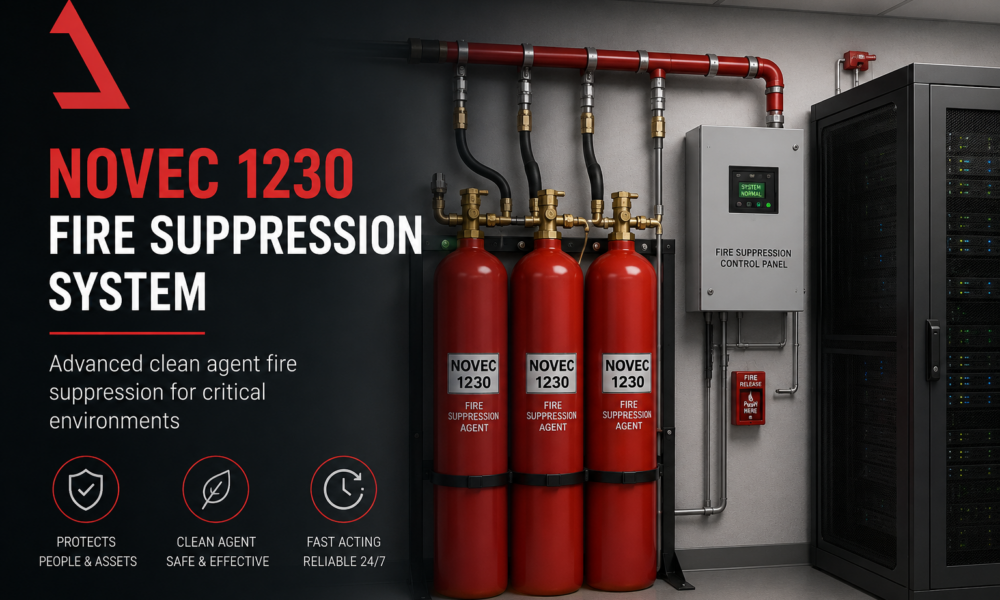
A typical Novec 1230 fire suppression system consists of:
- Detection system — smoke or heat detectors that identify a fire at its earliest stage
- Control panel — processes signals from detectors and triggers the release mechanism
- Storage cylinders — pressurized tanks holding the Novec 1230 agent
- Piping network and nozzles — engineered to distribute the agent evenly across the protected space
- Alarm and abort stations — allow manual activation or abort during false alarms
When a fire is detected, the system releases the agent within seconds, flooding the protected enclosure to a pre-calculated concentration that suppresses combustion before it spreads.
Fire Fighting System Installation: Step-by-Step Process
Proper fire fighting system installation is just as important as choosing the right suppression agent. A poorly designed or incorrectly installed system can fail when it matters most. Here is how a professional installation process typically unfolds:
1. Fire Adequacy Study and Risk Assessment
Before any installation begins, engineers assess the facility’s fire load, occupancy type, equipment layout, and applicable regulatory standards (NFPA, NBC, FM Global). This determines the right suppression technology — sprinklers, hydrants, clean agent systems, or a combination.
2. System Design and Engineering
Based on the assessment, a detailed design is prepared covering cylinder placement, pipe routing, nozzle positioning, detection zones, and agent quantity calculations. Accurate design ensures the room is flooded to the correct concentration without gaps in coverage.
3. Procurement of Certified Equipment
Genuine, OEM-certified components are sourced — cylinders, valves, detectors, control panels, and piping — each backed by test certificates. Using uncertified or counterfeit parts is one of the most common causes of system failure during real fire events.
4. Installation and Integration
Trained technicians install the piping network, mount cylinders, wire the detection and control systems, and integrate the suppression system with the facility’s existing fire alarm and building management systems.
5. Testing and Commissioning
Once installed, the system undergoes pressure testing, discharge testing (where applicable), and functional verification of detectors, alarms, and control sequences before being handed over.
6. Documentation and Compliance
A complete handover includes OEM certificates, as-built drawings, compliance documentation, and warranty details, ensuring the facility is audit-ready for fire NOC and insurance requirements.
7. Annual Maintenance Contract (AMC)
Ongoing testing, inspection, and servicing keep the system reliable over its operational life. Regular AMC visits catch issues like pressure loss, wiring faults, or component wear before they become failures.
Industries That Rely on Novec 1230 and Professional Fire Suppression Installation
- Data centers and server rooms — protecting servers without water damage risk
- Electrical panel rooms and switchgear — non-conductive agent safe around live equipment
- Manufacturing and pharmaceutical facilities — protecting high-value machinery and clean environments
- Paint booths — suppressing flammable vapor fires without residue
- Oil, gas, and chemical plants — high-hazard environments requiring rapid, reliable suppression
- Museums, archives, and heritage sites — protecting irreplaceable materials from water and residue damage
Why Work with a Specialized Fire EPC Company
Fire suppression system installation is a technical, safety-critical discipline. Choosing an experienced partner matters because:
- Designs must account for room integrity, agent concentration, and leakage paths to actually work during a fire
- Components must be genuine and OEM-certified to perform under emergency conditions
- Installation must comply with NFPA 2001 (for clean agent systems), FM Global standards, and National Building Code (NBC) requirements
- Ongoing maintenance is essential, since a suppression system is only as reliable as its last inspection
Agnim Engineerz has been designing and installing fire protection systems since 2017, working across Oil & Gas, chemicals, pharmaceuticals, engineering, and consumer goods industries, with clients including Whirlpool of India, Orient Electric, Metso Outotec, Bajaj Consumer Care, and King Koil. Our teams handle everything from fire adequacy studies and system design to certified installation, commissioning, and 24/7 AMC support, with pan-India project delivery.
Frequently Asked Questions
1. Is Novec 1230 safe for people if it discharges in an occupied room? Yes. Novec 1230 is designed to be used at concentrations that are safe for human exposure during normal design conditions, unlike CO2 systems which require immediate evacuation. However, standard safety protocols and evacuation procedures should still be followed as per NFPA 2001 guidelines.
2. How long does a Novec 1230 system last before it needs recharging? The cylinders themselves can last for decades with proper maintenance, but they require periodic pressure checks and recertification (typically every 5–12 years depending on cylinder type and local regulations) as part of an AMC.
3. What is the difference between Novec 1230 and FM-200? Both are clean agents, but Novec 1230 has a significantly lower global warming potential and is generally considered a more environmentally sustainable option, while offering comparable suppression performance.
4. Can Novec 1230 be used alongside sprinkler systems in the same facility? Yes. Many facilities use Novec 1230 for sensitive, high-value areas like server rooms or electrical panels, while relying on sprinkler and hydrant systems for general warehouse or production floor coverage.
5. How long does a typical fire fighting system installation project take? Timelines vary based on facility size and complexity, but a well-planned project — from design approval to commissioning — can often be completed within a few weeks to a few months for large industrial sites.
6. Do I need a Fire NOC after installing a suppression system? In most Indian states, a Fire No Objection Certificate (NOC) is required for commercial and industrial occupancy, and having a professionally installed, code-compliant fire suppression system is essential to secure it.
7. What maintenance does a Novec 1230 system require? Routine maintenance includes cylinder pressure checks, detector testing, control panel diagnostics, and piping inspection, typically performed under an Annual Maintenance Contract (AMC) with a qualified fire safety provider.
Get Expert Fire Suppression System Installation
If you are planning to install a Novec 1230 clean agent system or upgrade your facility’s existing fire protection infrastructure, working with a specialized fire safety EPC company ensures your system is designed correctly, installed with genuine components, and backed by ongoing support.
Agnim Engineerz offers end-to-end fire fighting system installation services — from fire adequacy studies and system design to certified installation and 24/7 AMC support — across industries in Delhi NCR and pan-India.
Call: +91 93115 92629 Email: ankur.t@agnimengineerz.com Visit: agnimengineerz.com