

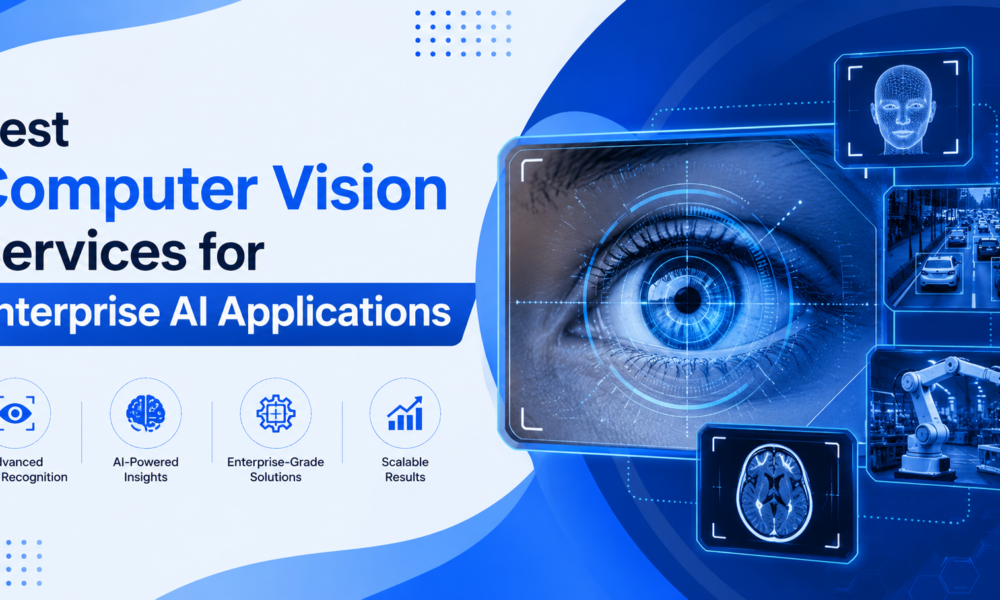
Best Computer Vision Services for Enterprise AI Applications
Walk into any boardroom discussing AI strategy today, and the conversation inevitably circles back to one question: how do we get machines to actually “see” and interpret the world the...

Walk into any boardroom discussing AI strategy today, and the conversation inevitably circles back to one question: how do we get machines to actually “see” and interpret the world the way our business needs them to? Enterprises across manufacturing, retail, healthcare, and logistics are no longer experimenting with vision-based AI as a side project — they’re betting core operational budgets on it. But the gap between a flashy demo and a production-grade system that runs reliably across thousands of cameras, devices, or data streams is enormous. That gap is exactly where the right partner makes or breaks the outcome.
Table Of Content
- Why Enterprises Are Pouring Budget Into Visual AI Right Now
- What Separates a Genuine Vision Partner From a Generic AI Vendor
- The Real Scope of Computer Vision Development Services
- Build In-House or Partner With a Specialized Firm
- Evaluating Computer Vision Software Development Quality Before You Commit
- Making the Decision to Hire Computer Vision Developers
- Bringing It All Together
This piece isn’t another generic list of “top 10 vendors.” Instead, we’re going to unpack what actually separates a capable vision partner from one that will leave you stuck mid-deployment, what enterprise-grade really means in this context, and how to evaluate the people you’re about to trust with a multi-year AI investment.
Why Enterprises Are Pouring Budget Into Visual AI Right Now
The shift didn’t happen overnight. For years, computer vision lived in research labs and niche industrial inspection lines. What changed is the convergence of cheaper edge hardware, more efficient deep learning architectures, and cloud infrastructure that can finally handle real-time video at scale. Add to that a labor market where skilled human inspectors, security personnel, and quality control teams are harder to staff, and you get a perfect storm where vision-based automation stops being optional.
Boards are now asking CTOs and operations heads a direct question: where is visual data being generated in our business, and why isn’t it being used to drive decisions automatically? That single question has opened budgets for everything from automated quality inspection on factory floors to shelf-monitoring in retail stores to fraud detection through document and identity verification.
A few patterns show up repeatedly across industries adopting this technology:
- Manufacturing leaders are replacing manual defect-spotting with camera-based inspection systems that catch flaws human eyes miss after hours of repetitive work.
- Retail chains are using shelf and footfall analytics to understand customer behavior without invasive tracking methods.
- Healthcare providers are layering vision models onto diagnostic imaging to flag anomalies faster, supporting rather than replacing radiologists.
- Logistics and warehousing firms are deploying vision systems for package sorting, damage detection, and inventory counting at speeds no manual process could match.
What Separates a Genuine Vision Partner From a Generic AI Vendor
Here’s something most business owners learn the hard way: a company that’s good at building chatbots or generic machine learning models isn’t automatically good at vision. Visual data is messy, high-dimensional, and brutally unforgiving of bad lighting, occlusion, or camera angles that weren’t accounted for during training. The skill set required — from data annotation pipelines to model optimization for edge devices — is genuinely specialized, and treating it as just another AI workstream is where many enterprise projects quietly fail.
A real computer vision development company brings domain-specific experience that shows up in the questions they ask before writing a single line of code. They’ll want to know about your camera placement, lighting variability across locations, the volume of data you can realistically label, and whether inference needs to happen on-device or in the cloud. Generic vendors skip these conversations and jump straight to model selection, which is usually the first sign of trouble ahead.
When evaluating potential partners, look for evidence of:
- A documented track record of taking vision projects from prototype to full production deployment, not just research demos.
- In-house expertise across the full stack — data engineering, model training, MLOps, and hardware integration.
- Experience handling edge cases specific to your industry, whether that’s low-light manufacturing floors or crowded retail environments.
- Transparent communication about model limitations rather than overselling accuracy numbers from a controlled test environment.
The Real Scope of Computer Vision Development Services
When people hear “computer vision,” they often picture a single model that detects objects in an image. In practice, computer vision development services cover a much broader and more layered set of work than most business owners initially expect. The model itself is often the smallest part of the engagement; the surrounding infrastructure is where most of the engineering effort and cost actually goes.
A thorough engagement typically starts with a discovery phase where the development team audits your existing data sources, camera infrastructure, and business workflows to understand feasibility before committing to a build. From there, the work moves into data collection and annotation, which is frequently the most time-consuming and underestimated part of any vision project — models are only as good as the labeled data they learn from.
The fuller scope generally includes:
- Custom model development tailored to your specific use case rather than relying on off-the-shelf models that weren’t trained on your environment.
- Data pipeline construction, including annotation tooling, data versioning, and continuous retraining workflows as new data comes in.
- Integration with existing enterprise systems such as ERP, MES, or CRM platforms so vision insights actually drive business action.
- Deployment architecture decisions, balancing cloud inference for flexibility against edge deployment for latency-sensitive use cases.
- Ongoing monitoring and model maintenance to catch performance drift as real-world conditions change over time.
Skipping any of these stages is usually where projects stall after the initial proof of concept looks promising in a controlled demo but falls apart once deployed across real locations.
Build In-House or Partner With a Specialized Firm
This is the question every business owner eventually has to answer, and there’s no universally correct answer — it depends on your timeline, budget, and how central vision AI is to your long-term competitive strategy. Building an internal team means hiring specialized computer vision developers, which is a slower and more expensive path upfront but can pay off if vision technology is going to be a permanent, evolving part of your product or operations.
Partnering with an external software development company gets you to market faster because you’re tapping into a team that has already solved many of the common engineering problems across multiple client engagements. The tradeoff is less direct control and a need to be more deliberate about knowledge transfer so you’re not permanently dependent on an outside vendor for every model update.
A hybrid approach is increasingly common among mid-to-large enterprises:
- Start with an external partner to validate the use case and get a working system into production quickly.
- Gradually build internal capability by having your own engineers shadow the external team during development.
- Retain the external partner for specialized work — like new model architectures or hardware optimization — while internal staff handle day-to-day maintenance.
- Reassess the build-versus-buy decision annually as the scope of your vision AI initiatives grows.
Evaluating Computer Vision Software Development Quality Before You Commit
Plenty of vendors will show you an impressive demo reel, but a polished video says very little about how their systems perform under the messy, unpredictable conditions of your actual business. Strong computer vision software development is measured by how well a system handles edge cases — poor lighting, partial occlusion, unusual angles, seasonal variation — not by how clean the curated demo footage looks.
Ask potential partners to walk you through a past project that didn’t go smoothly and how they resolved it. Vendors who can’t point to a real challenge they navigated are either inexperienced or unwilling to be transparent, and both are red flags for a long-term engagement. You should also ask how they handle model drift, since a vision system’s accuracy at launch is not the same as its accuracy six months later once environmental conditions shift.
Practical due diligence steps worth taking before signing a contract:
- Request references from clients in a similar industry, not just a generic portfolio of unrelated projects.
- Ask for a small paid pilot project before committing to a full-scale engagement, so you can evaluate working style and output quality directly.
- Clarify ownership of code, models, and data upfront, since some vendors retain rights that limit your future flexibility.
- Confirm their approach to security and compliance, particularly if the system processes sensitive footage involving people or proprietary facility layouts.
Making the Decision to Hire Computer Vision Developers
At some point, analysis has to turn into action, and that means deciding how you’re going to staff this initiative. The decision to hire computer vision developers — whether as full-time employees, contractors, or through an agency partnership — should be driven by how strategic this capability is to your business, not just by which option looks cheapest on paper this quarter.
For most business owners outside the tech industry, the fastest and lowest-risk path is partnering with an established firm for the first one or two projects, then making a more informed build-versus-buy decision once you’ve seen real results and understand the ongoing maintenance burden. This approach also reduces the risk of hiring developers who look strong on paper but lack the specific experience needed to ship a reliable production system.
Before finalizing your hiring or partnership decision, it helps to clarify internally:
- Which business problem the vision system needs to solve first, since trying to tackle everything at once is a common cause of project failure.
- What internal stakeholders — operations, IT, compliance — need to be involved from day one to avoid late-stage roadblocks.
- What budget you’re prepared to commit not just for development but for the ongoing maintenance every vision system requires.
- How you’ll measure success in concrete terms, whether that’s defect reduction percentage, labor hours saved, or detection accuracy thresholds.
Bringing It All Together
Computer vision has moved firmly out of the experimental phase and into the realm of serious enterprise infrastructure, and the businesses getting real value from it are the ones treating partner selection with the same rigor they’d apply to any major capital investment. Whether you choose to work with an established computer vision development company or gradually build internal capability, the fundamentals stay the same — start with a clearly defined problem, demand transparency about limitations, and resist the temptation to chase the flashiest demo over the partner with proven, unglamorous experience shipping systems that hold up in the real world. Get those fundamentals right, and visual AI stops being a buzzword on a strategy slide and starts becoming a genuine operational advantage.